The Group of Twenty (G20) is an international forum that brings together 19 advanced and developing countries (plus the European Union and the African Union) to discuss global economic affairs.
The G20 was constituted in 1999 as informal discussion forum for the finance ministers and central bank governors of the 20 systemically most important economies at the time, in the aftermath of the Asian financial crisis of 1997–98. Its purpose was to address and counter the financial fallout and contagion brought about by the Asian financial crisis, as well as preceding and subsequent crises, such as the Mexican peso crisis of 1994 and the Russian financial crisis of 1998. Following the 2008 global financial crisis, it was elevated to the level of heads of state/government and designated the ‘premier forum for international economic cooperation’. While the G20 initially focused on broad macroeconomic policy, its scope has since expanded to include governance, finance, digital economy, education, agriculture, trade, sustainable development, energy transitions, health, climate change and the environment, among other issues. The purpose of the G20 is to bring together the world’s major economies to discuss and coordinate economic and financial policies to create a more stable and prosperous global economy through international cooperation and coordination.
The G20 has hosted annual summits under the leadership of a rotating presidency among its member states since 2008. In the absence of a permanent secretariat, the G20 member country holding the presidency is assisted by the countries holding the previous and upcoming presidencies, representing the troika, to set the agenda for each year’s summit. The G20 process is led by the sherpas of member countries, who are personal emissaries of the leaders. The sherpas oversee negotiations throughout the year, discussing agenda items for the summit and coordinating the substantive work of the G20.
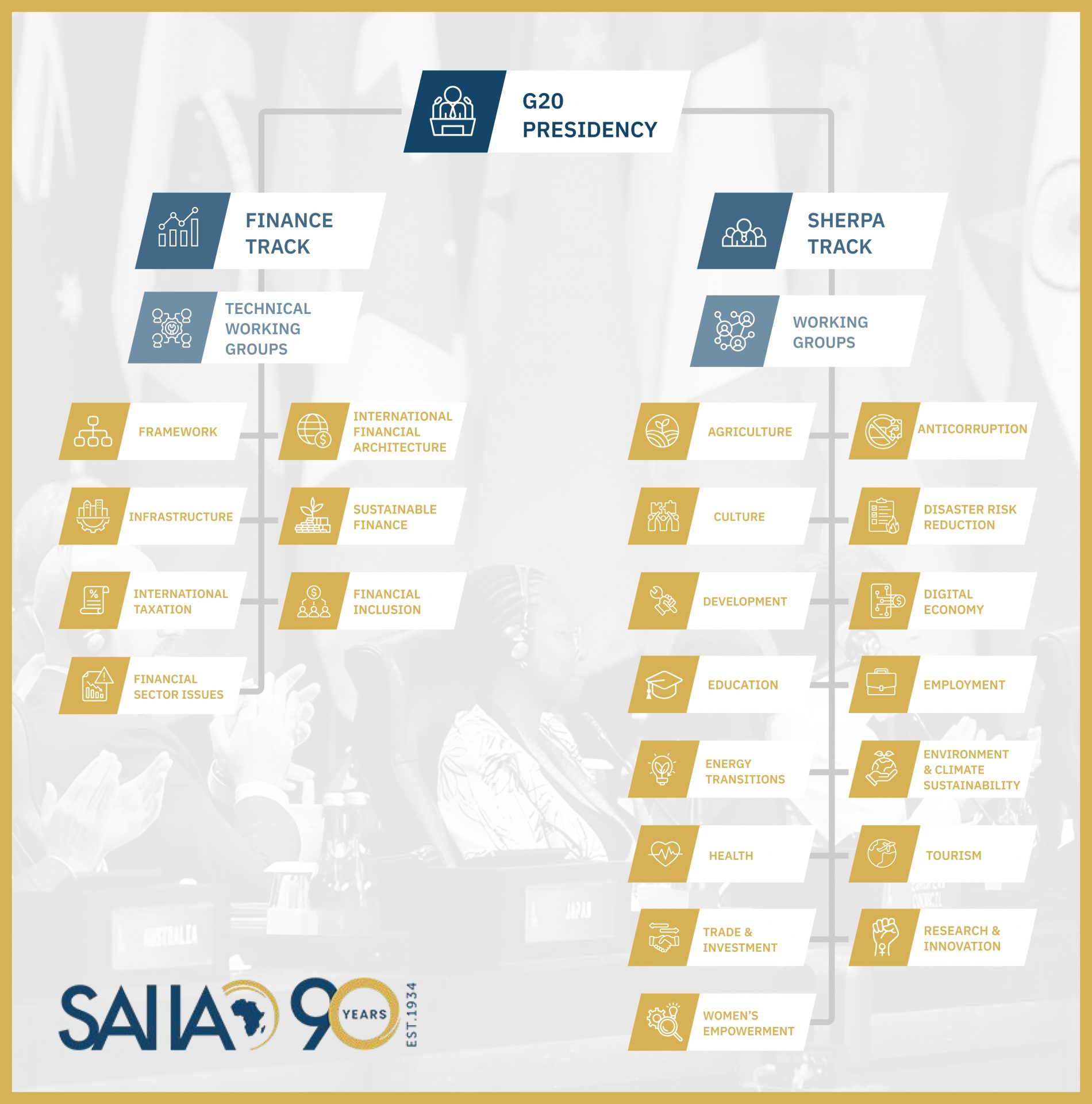
The G20’s work is divided into two tracks: the Finance Track and the Sherpa Track. Within these tracks, there are thematically oriented working groups, which include representatives from the relevant ministries of member countries, invited/guest countries and various international organisations. These working groups meet regularly throughout the term of each presidency. The agenda is informed and influenced by the contemporary geopolitical and economic context of each presidency, as well as by the tasks and goals agreed upon in previous years. The figure below illustrates the typical G20 governance structure with the areas covered under each of the tracks.
As part of the G20 members’ commitment to consult relevant stakeholder communities, dialogue is facilitated through various engagement groups. These groups often draft recommendations for the G20 Leaders, contributing to the policymaking process. The engagement groups are as follows:
Think20: This group brings together think tanks and research institutes from G20 member countries and countries invited by the rotating presidency. Its purpose is to provide evidence-based inputs into the G20 agenda and to propose well-researched ideas on how the G20 can address current and emerging challenges.
Business20: Private sector representatives/organised business that engage with G20 governments to propose public policies that promote the sustainable development of the private sector.
Civil20: Civil society organisations that engage with the G20 leaders to ensure that the recommendations of civil society are considered.
Labour20: Coordinated by the International Trade Union Confederation and the Trade Union Advisory Committee of the OECD, this group brings together trade union representatives from G20 countries and international trade union federations to advocate for workers’ interests in the G20.
Women20: This is a platform for women representatives from academia, entrepreneurship and civil society that advocates for women’s economic empowerment within the G20.
Youth20: This is a platform for dialogue between young people from G20 member countries to discuss and advocate for the inclusion of youth priorities in the G20 agenda.
Startup20: A platform that facilitates dialogue among key players in the startup and technology sectors in the G20, as well as small and medium-sized enterprises.
Science20: The grouping of the national science academies of the G20 countries that promotes dialogue between the scientific community and policymakers.
Urban20: A city diplomacy initiative that unites cities from G20 member countries to foster dialogue and political collaboration on recommendations addressing economic, climate and development issues in urban areas.
Parliament20: A platform for G20 country parliaments to actively contribute to global issue deliberations. It fosters interparliamentary cooperation and enhances engagements among governments, parliaments and other stakeholders for effective implementation of various G20 outcomes.
SAI20: Representatives from the G20 Supreme Audit Institutions (SAI20) that play a crucial role in strengthening cooperation among these institutions and demonstrating a commitment to promote transparency, accountability and effectiveness in global governance.
Justice20: The J20, also called the Supreme Courts and Constitutional Courts engagement group, exchanges ideas and promotes initiatives concerning contemporary legal topics to establish a global forum for constitutional jurisdiction bodies.
Oceans20: Debuting under the Brazilian presidency of the G20, Oceans 20 had its embryo in the last two G20 cycles, under the presidencies of Indonesia and India, and will play an important role in giving civil society a voice on issues related to the ocean.
Township20: The South African presidency has expressed intentions to support the establishment of a new engagement group, the Township20, with an aim to spotlight the potential of South Africa’s township economies.
G20 Presidencies
The G20 leadership is based on the principle of annual rotation among its members, which host annual summits where decisions of mutual interest are made by consensus.
The United States currently holds the 2026 presidency, officially launching the second round of rotating G20 presidencies. In contrast to the expansive agendas of its predecessors – including South Africa – the US is concentrating on an economic agenda. To achieve this, it has streamlined its focus into four working groups: Trade, Growth and Deregulation, Innovation and Energy Abundance.
To ensure continuity between presidencies, there is a troika system, which was adopted at the Cannes Summit in France in 2011. The troika is made up of the incumbent presidency, the previous and the next presidencies.
G20 Members
United Kingdom
NextG20 Presidency
United States
Current G20 Presidency
South Africa
Previous G20 Presidency
The G20 membership is made up of the world’s 19 major and systematically important economies and two continental unions. The members are Argentina, Australia, Brazil, Canada, China, France, Germany, India, Indonesia, Italy, Japan, Republic of Korea, Mexico, Russia, Saudi Arabia, South Africa, Türkiye, the UK, the US, the AU and the EU. Collectively, these members account for 85% of global gross domestic product, 75% of international trade and two-thirds of the global population. In addition, the G20 incumbent presidency, at its own discretion, invites guest countries each year to participate in the G20 proceedings.
Despite the G20’s pivotal role in Africa’s future, traditionally the grouping has not involved the African continent in its inner workings. Only one African country (South Africa) has been a permanent member since the formation of the grouping, until the AU was formally admitted during the 2023 Indian Presidency. Prior to the 2023 decision, the AU enjoyed observer status at the G20 alongside the AU Development Agency (AUDA-NEPAD). AUDA, as an agency of the AU, now participates in some of the working streams. Past G20 meetings were also attended by the UN Economic Commission for Africa (UNECA) and the African Development Bank (AfDB), and they continue to do so. The AU’s admission as a full member of the G20 is significant because of the G20’s ongoing focus on global financial architecture reform, an endeavour that is a priority for African economies.
President of the G20
Member of the G20
Represented through membership of the African Union
Represented through membership of the European Union
Non-member of the G20
Invited non-G20 members
A few non-G20 member countries are invited by the G20 presidency to participate in the G20 process as guests. These countries vary from year to year, except Spain, which is a permanent invitee. South Africa, as the host of the G20 in 2025, invited the following countries to participate as guests: Denmark, Egypt, Finland, Ireland, New Zealand, Nigeria, Norway, Portugal, Singapore,, Switzerland, The Netherlands, and the United Arab Emirates.
The United States this year has invited 11 countries alongside Spain: Azerbaijan, Finland, Ireland, Kazakhstan, Norway, Poland, Qatar, Singapore, The Netherlands, United Arab Emirates (UAE) and Uzbekistan.
No regional organisations have been invited.
Invited International Organisations
The following international organisations are regular participants in the G20 process: