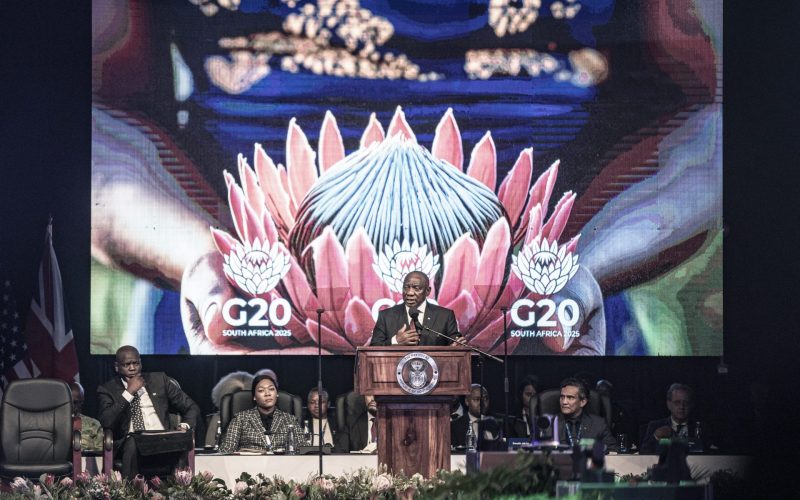

In a world where major global economic imbalances are widening as a result of structural national and international dynamics, particularly rapid technological revolutions, and where the friction they generate is fuelling nationalist dynamics within countries, resulting in a prioritisation of competitiveness, strategic autonomy and security, the G20 provides a platform that is more necessary than ever, where major economies and middle powers can still engage in dialogue. How do sustainable development issues fit into these conversations? Chief Programmes Officer at the IDDRI, Céline Kauffmann, provides an analysis of the outcomes of the G20 chaired by South Africa.
A Necessary Platform for Dialogue
The G20 was established and gained momentum in response to the financial crises of the 1990s and of 2008. Faced with these challenges, it offers a political platform enabling leaders (heads of state, but also finance ministers and others, and central bank governors) to meet regularly to advance issues discussed in working groups that remain relatively stable over time. The presidency also has considerable latitude to push more ‘personal’ issues, which subsequent presidencies are responsible for taking up or not.
Such a platform is essential at a time when antagonisms between major powers are making headlines and resulting in stalled negotiations. The four successive presidencies held by emerging economies (Indonesia in 2022, India in 2023, Brazil in 2024 and South Africa in 2025) have demonstrated the importance these countries attach to this club, which is limited in membership but highly influential in terms of its economic, demographic and environmental footprint. They have also shown their ability to put issues on the agenda and lead them, whether in relation to the reform of multilateral development banks or to inequality and poverty (IDDRI, 2025a).
A Complicated Sequence Ahead and a Risk of Paralysis
Paradoxically, just as the G20 seems to be attracting increased attention for its potential to build bridges across major economies, its capacity for action is being tested. Issues of international coordination are once again at the forefront, with imbalances that risk spiralling out of control and political responses that offer no reassurance.
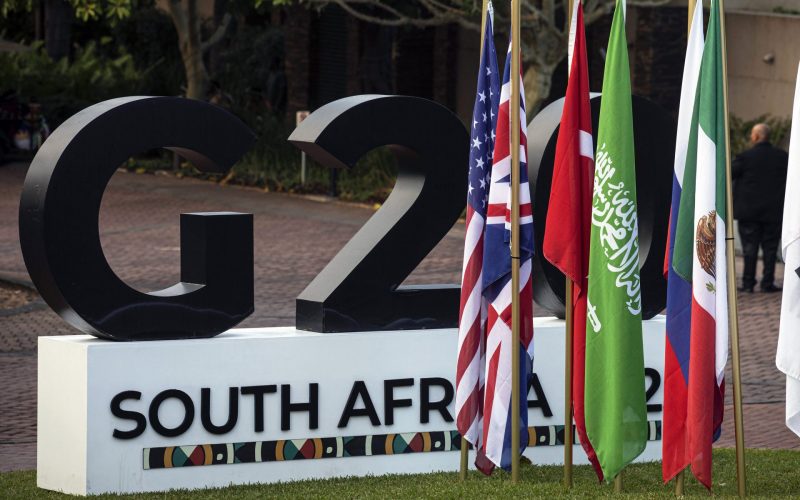
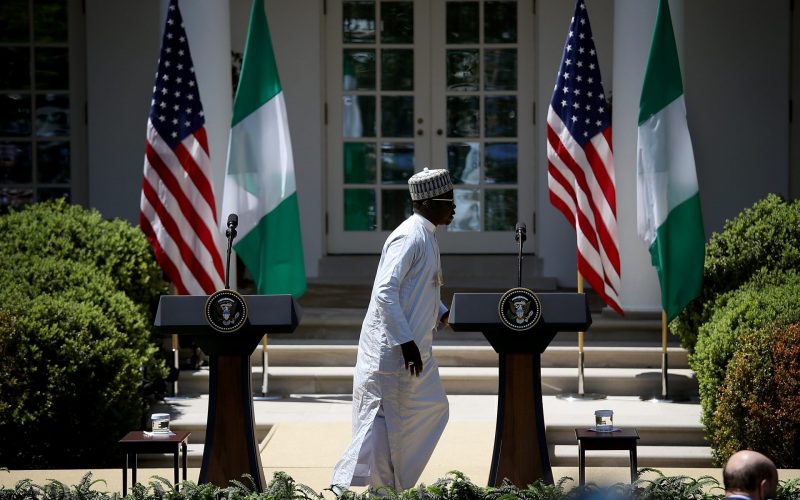
Faced with this urgent need for action, the G20 is drawing attention for its internal, almost “mundane” struggles: the US decided not to attend the summit, and the South African Presidency found itself faced with the dilemma of a handover in the absence of a successor (US, 2026) and what protocol to follow in this context. The Final Communiqué issued on behalf of the countries present in Johannesburg1V2-22-November-Final-G20-South-Africa-Summit-22-23-November-.pdf reflects their efforts to overcome this challenge.
And the question arises for future summits: what will a sceptical presidency decide to make of the G20? How to recover from a “lost year” (before the handing over to the UK in 2027) on issues that the US have already decided to exclude from the discussions, such as those addressed in the environment and climate working group or in the sustainable finance working group, whose fate is still uncertain? Worse, how to deal with a year marked by increased imbalances due to a G20 that is more harmful than helpful if, for instance, the aim is to reverse the phasing-out of fossil fuels to support digital development?
For several years now, the G20 has been unable to tackle major issues: despite progress in the area of climate change and repeated calls for action, the G20 countries, which are the world’s largest emitters of greenhouse gases, seem to be turning their backs on their necessary and expected leadership. Their nationally determined contributions (NDCs), submitted under the Paris Climate Agreement, have either been late.2As of 5 November 2025, the NDCs for India, Korea and Argentina were still missing. or fallen short of expectations, and there has been a clear lack of coordination in contrast to the momentum in 2015 that led to the adoption of the Paris Agreement.
Once again, the G20 might fail to address the issues that are destabilising the world today, both in terms of uncontrolled economic dynamics (overcapacities in China, US trade imbalances, underinvestment in Europe and rising debt, particularly in vulnerable countries) and erratic, uncoordinated policy responses (trade tariffs and the race for raw materials).
An African Presidency Promoting an African Agenda
In this context, South Africa’s G20 Presidency in 2025 was highly symbolic: it was the first to be held in Africa, and the first time that the AU was represented. It was also eagerly awaited for its ability to bring issues linked to development to the continent to the forefront, including:3Africa’s Moment: South Africa’s G20 Fight to Centre Development – SAIIA inequalities, debt, cost of capital and illicit financial flows, food security, just energy transition and digital catching-up.
On at least two issues, the presidency commissioned the services of eminent figures to produce expert reports and propose recommendations that could carry on South Africa’s legacy and mitigate the weakness of G20 commitments.4South Africa’s G20 presidency: diplomatic victory, but a weak final declaration On debt, the expert report commissioned by the presidency from former Finance Minister Trevor Manuel highlights, inter alia, the need for a club of recipients, similar to the clubs of donors that already exist.5FINAL-AEP_Report_Individual_Pages_v251115.pdf On inequalities, the presidency also commissioned a report to Joseph Stiglitz,6Landmark G20 Report Led by Nobel Laureate Joseph Stiglitz Sounds Alarm on ‘Inequality Emergency’ and Calls for International Panel on Inequality. – Initiative for Policy Dialogue which led to a call from heads of state, organisations of all kinds and experts for the establishment of a permanent scientific monitoring body, some sort of ‘IPCC for inequalities’.
What About Sustainable Development?
Whether we look at the progress made by the working groups, the ministerial meetings or the Final Communiqué, the results from an environmental perspective are limited. The ministerial meeting held in mid-October 2025 produced two declarations: one on crimes against the environment and one on air quality. In both, the language recognises the problems and the importance of addressing them but fails to propose practical collective actions. And one cannot help but note the weakness of the collective ambition on issues such as climate change mitigation and adaptation, plastic pollution and deforestation.
The Final Communiqué itself fails to mention transitioning away from fossil fuels, despite the long-standing G20 commitment to phase out inefficient fossil fuel subsidies and the text reiteration of the targets to triple renewable energy and double energy efficiency.
While the South African Presidency did not tackle environmental issues head-on, which would certainly have had little chance of success in the current geopolitical climate anyway and may have suffered from tension with social issues (hence the dropping of the climate working group established by the Brazilian Presidency in favour of three groups focusing on inclusive growth, food security and AI), the four priorities selected by the presidency7G20 Presidency – G20 South Africa:1) Strengthening disaster resilience and response; 2) Taking action to ensure debt sustainability for low-income countries; 3) Mobilising finance for a just energy transition; 4) Harnessing critical minerals for inclusive growth and sustainable development. are undeniably important pieces of the sustainable development puzzle and skilful ways of pushing the G20 agenda in this direction.
South Africa can claim to have fully embraced the challenges associated with new industrial policies. The working group dedicated to inclusive growth, industrialisation, employment and inequality reduction has produced Principles for Sustainable Industrial Policy and a Governance Framework for Critical Minerals, which covers a wide range of issues, including value creation in producing countries. This is clearly a subject to be closely monitored at the interface between the G7 and G20 (between value chain security and development leverage for producing economies), with particular attention to environmental impacts that might be overlooked. This is about the value chains of tomorrow’s economy (in support of the digital and green transitions), whose upheavals are precisely what the countries of the South raised as a topic of discussion at COP30 (IDDRI, 2025b).
Next, the South African Presidency raised the profile of issues relating to natural disaster risk management and resilience building. This is the first topic addressed in the Final Communiqué. Although the discussions did not translate into concrete measures, they led to a ministerial declaration on natural disaster risk reduction8 2025_G20_DRR_Ministerial_Declaration_Final.pdf and the launch of high-level principles on investment in support of this reduction.9https://g20drrwg.preventionweb.net/media/105538/download?startDownload=20251124 The working group on sustainable finance addressed the limits of insurance processes, drawing in particular on technical work by the World Bank and the International Association of Insurance Supervisors regulators’ forum,10SFWG-P2b_Insurance-Protection-Gap.pdf and proposed a series of recommendations as part of its report on sustainable finance 2025 (alongside recommendations on adaptation finance and carbon credit markets).112025-G20-SFWG-Presidency-and-Co-chairs-Sustainable-Finance-Report_vf.pdf This was a topic that resonated strongly at COP30 in Belém, and this is likely to continue in the coming years.
These developments are unlikely to be consolidated under the US G20 Presidency, but they do identify areas that subsequent presidencies, as well as the French G7 Presidency, could take up.
This article was first published by the Institute for Sustainable Development and International Relations.