
The beginning of Russia’s war against Ukraine in 2014 and the full-scale invasion in 2022 reshaped the Kremlin’s foreign policy toward Africa, as it drove Moscow to engage more partners outside Europe and North America. Amid this trend, Southern Africa, which has liberation-era ties to the Soviet Union, abundant minerals, and a geostrategic position spanning the Atlantic and Indian Oceans, has reemerged as a more active arena for Russian diplomacy.
Russia’s appeal to Southern African states is evident, with Moscow’s rhetoric clearly resonating in some key areas. It routinely invokes its support for anti-colonial struggles dating to the Soviet period, support that is the bedrock of its ties. Russia rejects Western dominance and offers African states an alternative partner. And Russia routinely calls for building a multipolar order that aligns with the AU’s own calls for global governance reform.
Despite its appeal and recent activism, Russia faces at least three major obstacles to further expanding its influence in Southern Africa. First, Moscow’s foreign policy is over-reliant on symbolism. Much of Russia’s influence rests on history and rhetoric, with few tangible benefits for African partners. Second, its economic weakness, in the face of sanctions, difficult geography, and a stagnating economy, limits investment capacity and puts Russia at a disadvantage in trade, aid and infrastructure provision in Africa compared to more economically powerful players such as China, the EU, the US, and even the Gulf states. Finally, many African civil society organisations and citizens have negative perceptions of Russia and criticise their governments for solidarity with an authoritarian state conducting a brutal, unjust war in Ukraine. Though Moscow seeks to revive old connections and carve out new opportunities in trade, energy, security and multilateral politics, these barriers limit its reach, creating a gulf between Russia’s rhetoric and results.
Diplomatic Engagement Since 2022
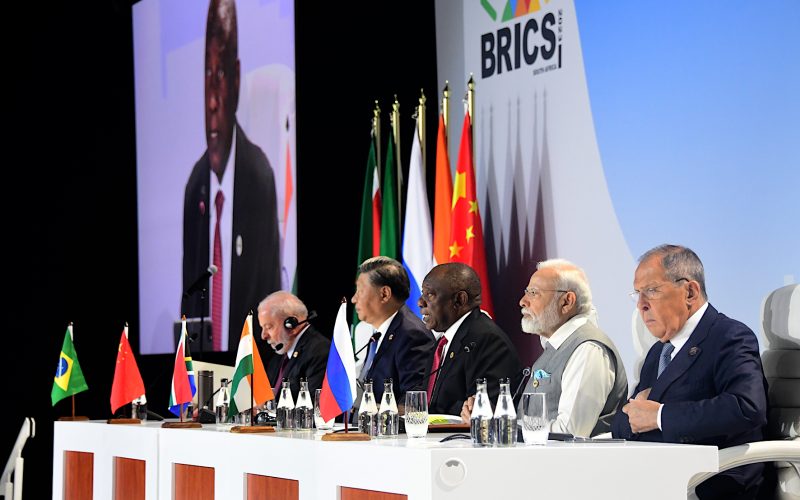
Russia stepped up its outreach to Southern Africa, especially after its invasion of Ukraine, to counteract international isolation. Russia will have embassies in 13 out of 16 member states of the Southern African Development Community (SADC) when it opens its new embassy in Comoros but South Africa remains the pivotal state for Russia in the region. South Africa’s position in BRICS provides Moscow with diplomatic cover and a partner willing at times to contest Western narratives internationally. Mozambique and Angola have pursued more pragmatic, hedging strategies, balancing Russian links with Western and Chinese partnerships.
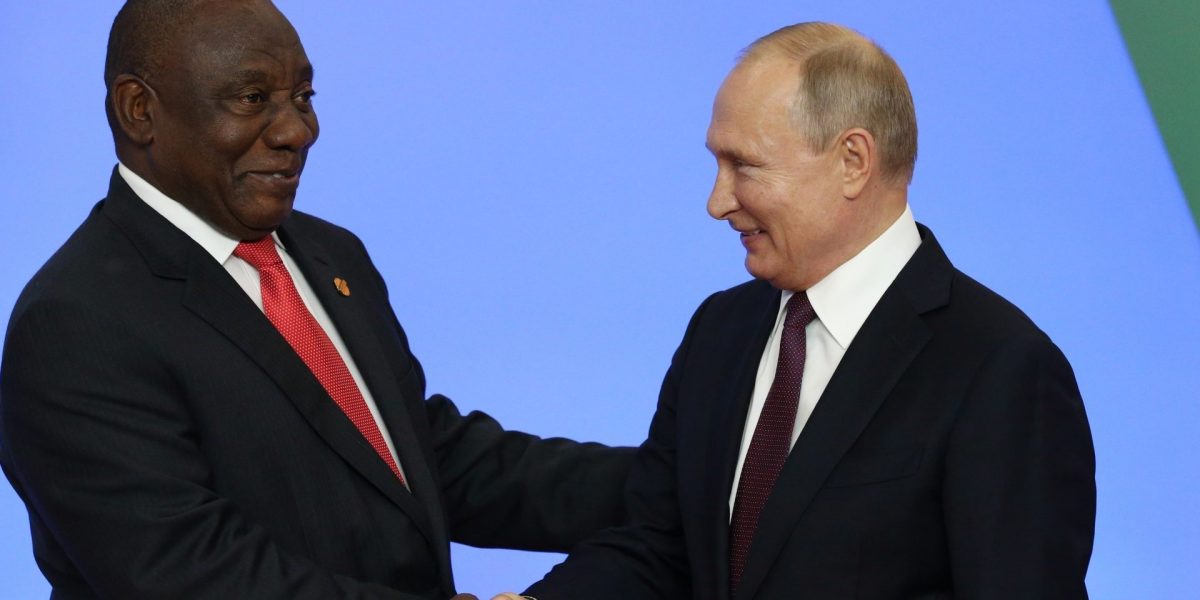
High-level visits from Russian Foreign Minister Sergey Lavrov and other senior officials are a key part of the Russian toolkit. Lavrov has visited Southern Africa four times since 2022, even as Russian President Vladimir Putin has been absent, unable to attend the BRICS Summit in 2023 or the G20 Summit in 2025 in South Africa because of an arrest warrant issued by the International Criminal Court. With the notable exceptions of Botswana and Lesotho, Southern African states have sent high-ranking officials to Russia for bilateral engagement or multilateral conferences on at least 15 occasions since February 2022.
These examples of high-level diplomatic engagement largely serve as political signaling exercises to counter perceptions of Russian isolation. Though familiar discussions on energy and education cooperation take place, tangible agreements are scarce. In Moscow’s largest overture, it pledged to forgive $23 billion of African countries’ Soviet-era debts during the 2023 Russia-Africa Summit in St. Petersburg, a move that was more symbolic than substantive, given that much of the debt was already unserviceable. At the same event, amid concerns about food security emanating from the Ukraine war, Moscow announced grain shipments but only to six politically aligned countries (Burkina Faso, Central African Republic, Eritrea, Mali, Somalia and Zimbabwe), with Zimbabwe as the sole Southern African recipient. The quantities were small and the exercise underscored Moscow’s penchant for symbolic acts and public relations.
Indeed, Russian diplomacy is often focused on pushing back on unwelcome initiatives. In Mozambique, for example, Lavrov offered counterterrorism support during a June 2023 visit that followed just days after Ukraine’s foreign minister pledged to open an embassy in Maputo, a position Moscow reiterated again in July 2025. Similarly, his January 2023 Angola visit followed President João Lourenço’s call for a “definitive and unconditional ceasefire by Russia.”
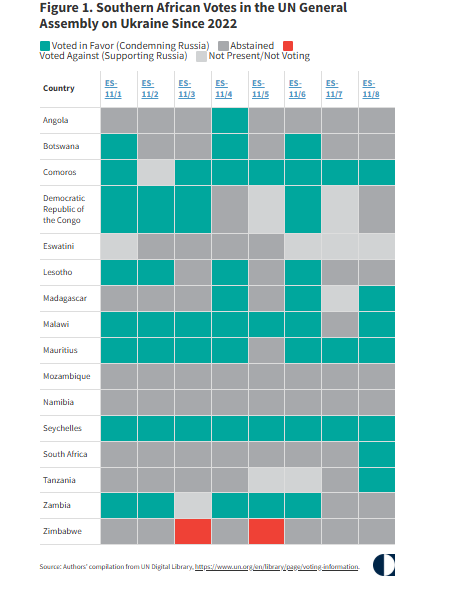
A close look at how Southern African states voted at the UN General Assembly on Ukraine provides one metric for Russia’s diplomatic ties and influence in the region and the results are decidedly mixed (see figure 1). Most SADC countries have consistently abstained on the assembly’s resolutions condemning Russia’s invasion. In South Africa, abstentions have drawn criticism from domestic political parties, religious leaders, and civil society organisations such as Amnesty International South Africa and the (now defunct) Brenthurst Foundation, which have all urged the government to defend international law more clearly. Mozambique and Namibia have abstained on every vote since 2022 on Ukraine, while Zimbabwe, which is under Western sanctions, stands out as the only SADC state that has supported Russia on occasion.
On the other end of the spectrum, Comoros and Seychelles voted against Russia in every single resolution condemning the invasion, reflecting small island states’ dependence on the UN Charter and multilateral law for their security. As beneficiaries of EU-anchored maritime security programs, both countries also share strategic incentives to align with EU member states. Democratic Republic of the Congo and Malawi, both heavily dependent on Western aid, supported Ukraine in at least half of the eight related resolutions since February 2022. Mauritius and Zambia did the same, the latter being particularly eager to signal pro-Western credentials under President Hakainde Hichilema.
Historical Legacy: Liberation Ties and Political Memory
History often underlies Russia’s diplomacy when it is successful in the region. The Soviet Union heavily backed African liberation movements during the Cold War, supporting their struggle against colonial and White-settler minority rule. These bonds created a legacy of political affinity. Southern Africa was central: South Africa’s ANC party and similar liberation movements in Angola, Mozambique, Namibia, and Zimbabwe all received Soviet arms, training, and scholarships to study at Russian universities. All of these former liberation movements currently remain as ruling parties in their countries (or in ruling coalitions), albeit with diminishing public support. Leaders frequently invoke solidarity with Moscow as repayment for past loyalty. South Africa’s ANC, in particular, has used this narrative to justify its nonaligned stance on the Ukraine war, which critics charge is actually pro-Russia.
Moscow has sometimes been able to generate controversy in South Africa, meddling in its fractious politics. Examples include the scandal around Duduzile Zuma-Sambudla, the daughter of former president Jacob Zuma who is accused not only of inciting violence during her father’s 2021 jailing but also of allegedly recruiting South African men to fight for Russia in Ukraine; the generous funding of the ANC by Russian mining oligarch Viktor Vekselberg; and a failed nuclear deal with South Africa, canceled when Zuma was ousted.
Yet generational change is weakening the resonance of these liberation ties and there are mixed feelings toward Moscow among younger elites and civil society. Russia now needs more than romanticised nostalgia to sustain its influence. And what is often forgotten, or deliberately obscured, is that other post-Soviet states can lay a claim to supporting these movements. Some ANC members, for example, received military training in the 1960s in what is now modern Ukraine.
Economic and Trade Relations: Big Talk, Modest Results
Complicating efforts to expand on its historic and political ties, Russia’s economic footprint in Southern Africa remains modest compared to China, the EU, and the US (see figure 2). In 2024, Russia barely made up 1% of Southern Africa’s external trade. By comparison, China accounted for over 22% and the EU over 15%.
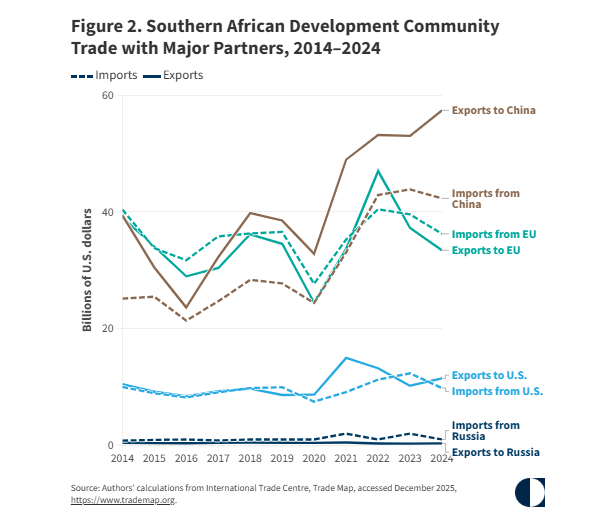
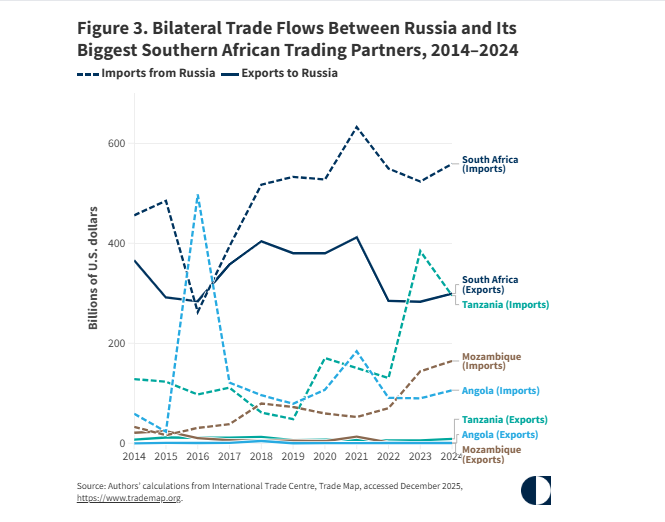
Exports to Russia collapsed in most Southern African countries post-2022 but some exceptions showed significant recovery in 2024 (such as for Madagascar). Overall, imports from Russia remained far above export levels (see figure 3), proving more resilient and in some cases even surging since 2022, including for Mozambique and Tanzania. In Angola, Mozambique, and Tanzania, such one-sided flows have produced stark trade imbalances. South Africa stands out as the most important and stable trade partner for Russia in Southern Africa, with less pronounced trade disruptions over the past years. In the first half of 2025, Russia-South Africa trade slightly expanded, even if still dwarfed by other trading partners.
There are specific industries where Russia is a bigger player, including supplying fertiliser and in the natural resource sectors. Russian mining companies have operated in countries such as Zimbabwe and South Africa. Rosatom leads in marketing Moscow’s nuclear technology across the region, though progress is slow and uneven. Russia is positioning itself for nuclear business with Namibia, South Africa and Zimbabwe, but all of these projects are nascent.
Sanctions, particularly exclusion from the Society for Worldwide Interbank Financial Telecommunication (SWIFT) banking system, limit Russia’s ability to finance major projects. In 2025, for example, Russia’s ambitions to build deeper economic links to the region suffered another blow when Gazprombank, which is under Western sanctions, failed to deliver planned funding for the Mossel Bay gas refinery in South Africa. Governments are wary of depending on a partner with such deep economic constraints. Disruptions and higher risks in Black Sea shipping routes, with goods often rerouted through third countries, have further raised trade costs and contributed to delays. Given these challenges, Moscow lacks the trade and economic heft to compete outright with Beijing or Brussels.
Military and Security Cooperation: Russia’s Strong Suit
Russia has a greater comparative advantage in Southern Africa when it comes to security cooperation. Weapons sales and training are a part of Russia’s appeal, more so than the mercenaries who have taken a prominent role in Russian foreign policy in other parts of the continent. Between 2018 and 2022, Russia was the largest supplier of arms imports to West, East, Central and Southern Africa collectively, providing 26% of all arms. However, in the 2019-2023 period, its share fell to 17%, while China’s stood at 19%. Angola, which has long been Russia’s largest arms client in Southern Africa, in late 2022 openly denounced prior plans to host Russian arms factories, instead declaring its intention to align more closely with the US and NATO on defense procurement. With much of Russia’s defense-industrial capability absorbed by the war in Ukraine, its capacity to project influence through security partnerships in Southern Africa has come under strain.
Still, Russia maintains military cooperation agreements with all large Southern African countries and continues to train officers from countries like South Africa and Zimbabwe at Russian military academies, which helps sustain elite ties. South Africa has also hosted joint naval drills with Russia and China, most notably February 2023’s Mosi II exercises, coinciding with the first anniversary of Russia’s second invasion of Ukraine. Western-sanctioned ships have docked in South African ports, also inviting controversy.
Soft Power and People-To-People Links
Though Russia’s cultural appeal is limited, it is making investments in soft power projection, focusing on education and media. Echoing Soviet-era strategies, Russia uses study abroad scholarships to cultivate goodwill among top Southern African students, reinforcing long-term pro-Russia alignment among the region’s emerging elite and decision-makers. In November 2024, at the first ministerial conference of the Russia-Africa Partnership Forum, Russia announced the allocation of 4,816 scholarships for African students in the 2025-2026 academic year, a slight increase from the previous year, while the overall number of African students tripled over the past decade. Angola, Zambia, and Zimbabwe received the highest scholarship quotas in Southern Africa, mirroring their comparatively large enrollments of students in Russia. However, of the more than 35 000 total African students in Russia in 2022-2023, only roughly 10% came from SADC member states, which is disproportionately low given that the region accounts for around one quarter of Africa’s total population.
Russia has also expanded its media presence, with the state-controlled outlets RT and Sputnik providing alternative narratives that resonate with anti-Western sentiment in African states. The removal of RT from DStv, the satellite offering in Southern Africa, due to EU sanctions on Russia in March 2022, has been a considerable setback for the channel that used to broadcast throughout Africa.
Conclusion: Pragmatic Partnership, Not Strategic Dominance
Russia’s ties to Southern Africa are real but limited by key constraints. Moscow offers diplomatic solidarity, security partnerships and selective economic cooperation, and Southern African states view it as a useful partner of convenience, providing alternatives, hedging space and political cover. But Russia lacks the financial might and development model that China or Western partners bring, and few governments see Moscow as a core economic partner.
As the global order fragments, Russia will continue to court Southern Africa. Liberation nostalgia and anti-Western narratives will be powerful tools but long-term influence will depend on whether Moscow can deliver concrete economic and developmental gains. Without them, its role in the region will remain symbolic and transactional, rather than transformative.
This chapter features in a compendium titled ‘Russia in Africa: Examining Moscow’s Influence and Its Limits‘ published by the Carnegie Endowment for International Peace.