
Recommendations
- Donors, governments and intermediaries should ensure that EbA respects universal human rights in local contexts by aligning its co-design, implementation, reporting and monitoring with Section C considerations of the KMGBF.
- Legal frameworks should be co-created by state and non-state actors. These should recognise Indigenous and local communities as custodians of conservation practices and advocate for equitable EbA approaches that align with culturally based practices and livelihoods.
- National climate and biodiversity coordination units/mechanisms should be established to ensure that EbA is correctly integrated, tracked and monitored across sectors and ministries in alignment with national development objectives and the goals of UN conventions.
- Networks and platforms such as FEBA, the CDKN, Panorama Solutions and the CBA Conference should be leveraged to integrate and highlight rights-based EbA evidence from local experiences at global forums, including UN climate change and biodiversity conferences.
Executive Summary
Under certain climatic and socio-economic conditions, ecosystem-based adaptation (EbA) can be more cost-effective, scalable and equitable than conventional top-down climate adaptation approaches. EbA uses biodiversity and ecosystem services to help people adapt to climate change. However, its effectiveness depends on how it is implemented and the appropriateness of its application. Section C of the Kunming Montreal Global Biodiversity Framework (KMGBF) outlines key considerations for designing and implementing EbA. Central to this is the application of a human rights-based approach (HRBA), which addresses power imbalances by anchoring actions in international human rights law.
Examples from Benin and Kenya demonstrate how EbA can safeguard local livelihoods by integrating Indigenous knowledge and inclusive, participatory practices into biodiversity planning and implementation. This empirical experience informs how EbA contributes to multiple Sustainable Development Goals (SDGs), enhancing resilience and promoting social and environmental justice. These lessons can inform knowledge exchanges and mutually supportive ambitions by states parties under the Rio Conventions.
Introduction
There is growing evidence that, under certain climatic and socio-economic conditions, EbA is more effective and equitable than top-down, conventional climate adaptation approaches.1H.-O. Pörtner et al., eds, Climate Change 2022: Impacts, Adaptation, and Vulnerability, Contribution of Working Group II to the Sixth Assessment Report of the Intergovernmental Panel on Climate Change (Cambridge University Press, 2022). The Convention for Biological Diversity (CBD) defines EbA as ‘the use of biodiversity and ecosystem services as part of an overall adaptation strategy to help people to adapt to the adverse effects of climate change’2Secretariat of the Convention on Biological Diversity, Connecting Biodiversity and Climate Change Mitigation and Adaptation, Report of the Second Ad Hoc Technical Expert Group on Biodiversity and Climate Change, Technical Series 41 (SCBD, 2009). EbA has multiple co-benefits for society, including climate resilience, biodiversity protection and socio-economic improvements. It thereby also supports multiple SDGs, while having cascading multiplier effects across the UN Rio conventions (addressing climate change, biodiversity and desertification, respectively).3The three UN Rio conventions are the Convention for Biological Diversity (CBD), the UN Framework Conventions on Climate Change (UNFCCC) and the UN Convention to Combat Desertification (UNCCD). EbA therefore has the potential to deliver multiple benefits and contribute towards the implementation of various global policy frameworks. However, such efforts can be truly transformative and equitable only when EbA interventions are well-designed and effectively implemented.
Linking Biodiversity and Climate Action Through the Kunming-Montreal Global Biodiversity Framework
In recent years, leaders have called for the alignment of climate and biodiversity actions to foster integration and coherence across climate and biodiversity policy processes.4Emily Goodwin et al., Harnessing Ecosystem-based Adaptation to Drive Progress on Implementing the Kunming Montreal Global Biodiversity Framework: Integrating Biodiversity and Climate Action across the Rio Conventions (Friends of Eco-Based Adaptation, 2024). By leveraging the two-way relationship between biodiversity and climate change, EbA can ensure that healthy ecosystems help protect people against the impacts of climate change, while climate action can help address pressing biodiversity challenges. EbA supports the expansion of habitats across land and seascapes that support species’ resilience to climate change. At the same time, it provides critical flows of ecosystem goods and services, including disaster risk reduction and other economic and non-economic benefits that bolster people’s well-being. Certain ecosystems can also sequester and store carbon, contributing to climate mitigation.5P.R. Shukla et al., eds, Climate Change and Land: An IPCC Special Report on Climate Change, Desertification, Land Degradation, Sustainable Land Management, Food Security, and Greenhouse Gas Fluxes in Terrestrial Ecosystems (Intergovernmental Panel on Climate Change, 2019).
The 2022 KMGBF supports the linking of climate change and biodiversity action through Targets 8 and 11. Target 8 calls for the use of EbA to minimise the impacts of climate change on biodiversity, while Target 11 calls for its use to enhance nature’s contribution to people, including ecosystem functions and services, while amplifying protection from natural disasters.6Convention on Biological Diversity, “Decision Adopted by the Conference of the Parties to the Convention on Biological Diversity: 15/4. Kunming-Montreal Global Biodiversity Framework” CBD/COP/DEC/15/4, December 19, 2022. The design and implementation of EbA interventions must ensure fair outcomes and avoid maladaptation.7Maladaptation is a process through which people become even more vulnerable to climate change often due to poor planning.
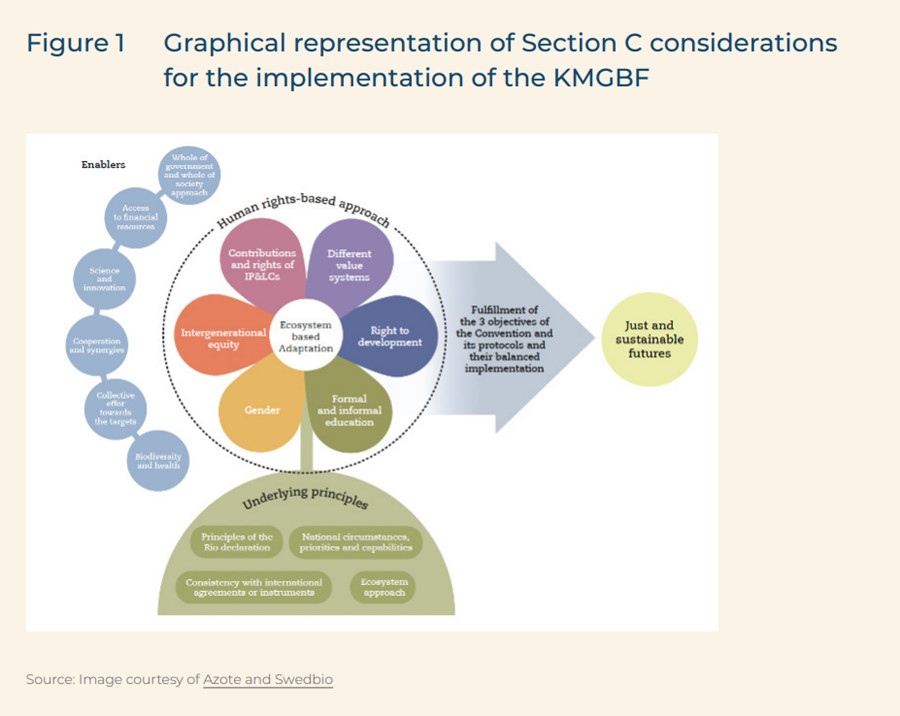
Section C of the KMGBF provides guidance on how approaches such as EbA should be applied, taking into account various best-practice criteria grounded in the principles of equity, inclusion and common-but-differentiated approaches. This includes, but is not limited to, an HRBA; the contributions and rights of Indigenous peoples and local communities; gender; a whole-of-government and whole-of-society approach; and access to financial resources. Without integrating these principles and approaches, EbA can further entrench inequalities by displacing communities or channelling investments away from those most vulnerable to climate change and biodiversity loss. Section C is thus vital for ensuring that EbA restores and protects nature, while safeguarding equity, agency and community resilience.8FEBA, “Centering Equity in Adaptation: Linking Section C and Targets 8 & 11 of the KMGBF with EbA”, accessed June 7, 2026.
Supporting Evidence for the Uptake of a Human Rights-Based Approach in EbA
Climate change is undermining human rights (for example, when people’s ancestral lands are lost to sea-level rise), while the ways societies respond to it can risk further breaching or undermining such rights. An HRBA ensures that EbA implementation is guided by international human rights standards and principles (including participation, accountability, non-discrimination, transparency and empowerment). It seeks to redress power imbalances by protecting rights-holders while also holding duty-bearers to account. All peoples are rights holders with respect to the environment; however, certain groups are disproportionately affected by climate change and biodiversity loss. Following the UN General Assembly resolution (A/RES/76/300) recognising a clean, healthy and sustainable environment as a universal human right, states and businesses have a duty to protect people’s human rights, including by protecting environmental human rights defenders. An HRBA can strengthen the capacities of both rights holders and duty bearers to claim their rights and fulfil their obligations.9CBD, “Guidance on Integrating Human Rights in National Biodiversity Strategy and Action Plans (NBSAPs)”, accessed June 7, 2026.
Implementing an HRBA often results in cascading benefits to both people and nature while helping to drive transformative change within unequal systems. This ensures that actions to restore and manage ecosystems actively contribute to the realisation of rights such as access to water, food, health, culture and a healthy environment.10Intergovernmental Science-Policy Platform on Biodiversity and Ecosystem Services, “Summary for Policymakers: Transformative Change Assessment”, accessed June 7, 2026; K. O’Brien, L. Garibaldi and A. Agrawal, eds, Thematic Assessment Report on the Underlying Causes of Biodiversity Loss and the Determinants of Transformative Change and Options for Achieving the 2050 Vision for Biodiversity of the Intergovernmental Science-Policy Platform on Biodiversity and Ecosystems (IPBES Secretariat, 2024); P.A. Harrison, P.D. McElwee and T.L. van Huysen, eds, Thematic Assessment Report on the Interlinkages among Biodiversity, Water, Food and Health of the Intergovernmental Science-Policy Platform on Biodiversity and Ecosystem Services (IPBES Secretariat, 2024). However, to ensure such approaches are scaled and embedded in policy and project design, evidence of the value of an HRBA in the context of EbA interventions must be mobilised from diverse contexts. This evidence must then be showcased globally and formally integrated through agreements under framework conventions and their instruments, such as the CBD through the KMGBF and the UN Framework Convention on Climate Change (UNFCCC) through the Paris Agreement. Various initiatives supported through the Climate and Development Knowledge Network (CDKN)11The CDKN is a Global South-led programme managed by SouthSouthNorth and implemented in partnership with Fundación Futuro Latinoamericano and ICLEI South Asia. It aims to accelerate equitable, financed and ecosystem-based action on climate change that is locally led and strengthens the voice and climate leadership of disadvantaged and marginalised groups. have applied an HRBA to EbA, with the potential to contribute to several of the KMGBF’s targets while applying Section C considerations (Figure 1). The following section describes two case studies from Benin and Kenya that show how local efforts can support international commitments. These two cases, along with other examples from diverse contexts, could be amplified through the knowledge-sharing and capacity-building mechanisms that exist under the climate and biodiversity conventions to support state and non-state actors in implementing more equitable EbA. The case studies also highlight the importance of integrating subnational practices into more formal governmental reporting channels to these international processes. Further evidence of the importance of an HRBA for EbA can be found on the websites of CDKN and Friends of EbA (FEBA).
Safeguarding Benin’s Sacred Forests Through Mobilising and Integrating Indigenous Knowledge Systems in Decision-Making
In Benin, deforestation is affecting the country’s biodiversity and associated livelihoods.12GIZ, “Forests4Future Country Package Benin”, July 2024 The drivers of deforestation are vast and complex, including climate change, agricultural expansion, illegal logging for timber and fuelwood, urban expansion and weak forest governance and enforcement.13World Bank, Benin Country Forest Code, Report (World Bank, 2020). Survie de la Mère et l’Enfant is working in six municipalities.14The municipalities are Dassa-Zoumè, Savè, Savalou, Bantè, Ouèssè and Glazoué. to promote EbA by restoring degraded areas. It also aims to protect Indigenous knowledge, such as that associated with sacred forest protection, which is integrated into formal biodiversity policy processes. Sacred forests are used by Indigenous communities for spiritual practices, with many associated with deities and ancestral spirits. They play a vital role in the cultural belief systems of many communities in Benin and support high levels of biodiversity because of cultural taboos that prevent illegal forest activities.15Edmond Totin, Esdras Obossou and Ferdinand Ayimasse, Bridging Indigenous and Western Knowledge Systems for Inclusive Forest-Based Resilience in Benin (CDKN, April 10, 2025). As such, the cultural value systems of traditional communities in Benin are actively safeguarding nature, which in turn supports ecosystem services.16Including soil fertility maintenance, water retention and microclimate regulation. However, sacred forests are at risk owing to deforestation and changes in societal structures, eg, certain Western institutions replacing Indigenous religions. Survie de la Mère et l’Enfant is working to create formal knowledge-exchange platforms that connect traditional healers and communities with local governments and researchers to advocate for communities’ rights and cultural practices through the preservation of sacred forests. Several municipalities are now considering integrating sacred forest management systems into their district development plans, and in 2025 a roadmap was developed to combine traditional and scientific approaches in forest governance. Advocacy efforts are also underway to mainstream Indigenous knowledge and associated practices in the National Forest Code.17Edmond Totin, Esdras Obossou and Ferdinand Ayimasse, “Traditional Knowledge Driving Local-Scale Business and Biodiversity Conservation in Central Benin”, CDKN, February 11, 2026.
Survie de la Mère et l’Enfant also supports restoration through the inclusion of youth and awareness raising to ensure Indigenous knowledge systems are passed down to future generations. Women are included in training on restoration and forest management to ensure their needs are integrated (such as firewood for cooking), with special attention given to gender equity in the establishment of forest management committees. During the restoration activities, traditional healers and forest custodians lead on species selection to ensure sacred forests can support traditional practices for medicinal use and spiritual rituals. This ensures that restoration activities align with local needs and values, thereby strengthening community ownership and creating stronger incentives to protect the forests.18Totin, Obossou and Ayimasse, “Traditional Knowledge Driving Local-Scale”. Currently, local communities are advocating for the development of a national inventory of traditional conservation practices to incentivise their integration into formal biodiversity planning.19Edmond Totin, Esdras Obossou and Ferdinand Ayimasse, “Integrating Indigenous Knowledge into Environmental Policies for Sustainable Forest Management in Benin”, CDKN, July 3, 2025.
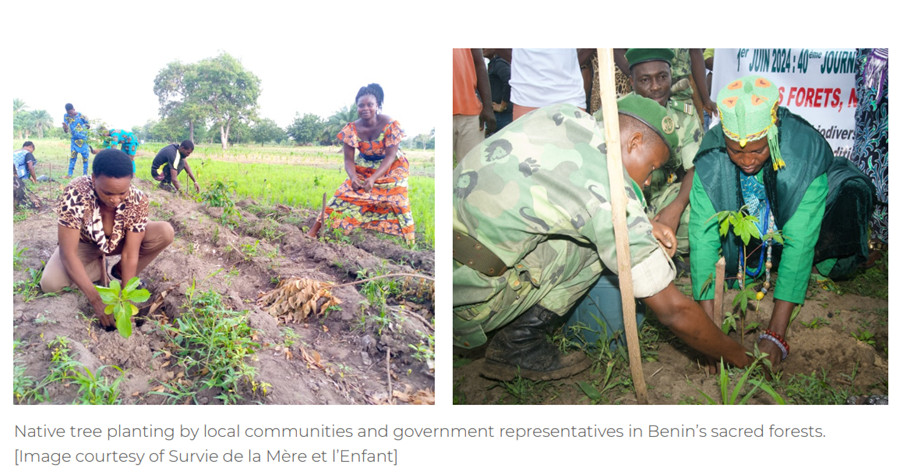
The work of Survie de la Mère et l’Enfant supports the implementation of the KMGBF by aligning with Targets 3, 8 and 11, and contributes to efforts towards 22 and 2320Target 3 aims to protect 30% of biodiversity by 2030; Target 8 aims to minimise the effects of climate change through EbA; Target 11 aims to restore, maintain and enhance nature’s contribution to people; Target 22 aims to ensure full, equitable, inclusive, effective and gender-responsive representation and participation in decision-making; and Target 23 aims to ensure gender equality in the implementation of the Framework through a gender-responsive approach. by promoting EbA and ensuring inclusive participation in biodiversity planning. Implementation towards these targets also aligns with KMGBF Section C considerations. This includes the contributions and rights of Indigenous peoples and local communities and the acknowledgement of different value systems, strengthened by an HRBA. By demonstrating the interconnection between communities’ belief systems and conservation practices, the project provides evidence for locally led approaches to biodiversity governance that recognise Indigenous knowledge as a key enabler of equitable EbA approaches.
Restoring Rangeland Ecosystems Through Traditional Pastoralist Conservation Practices in Mount Marsabit, Kenya
Marsabit is Kenya’s second-largest county, with 95% of the population depending on pastoral or agro-pastoral livelihoods. It is highly vulnerable to climate change and associated impacts, particularly drought.21Kiptoch William Ndiema, “Climate Change and Its Impact on Land Use: A Case Study of Marsabit County, Kenya”, Journal of Environmental Science and Technology 3, no. 1 (2025): 1–15. This puts pressure on pastoralist livelihoods, resulting in several negative knock-on effects, including increased human–wildlife conflicts and the over-exploitation of natural resources.
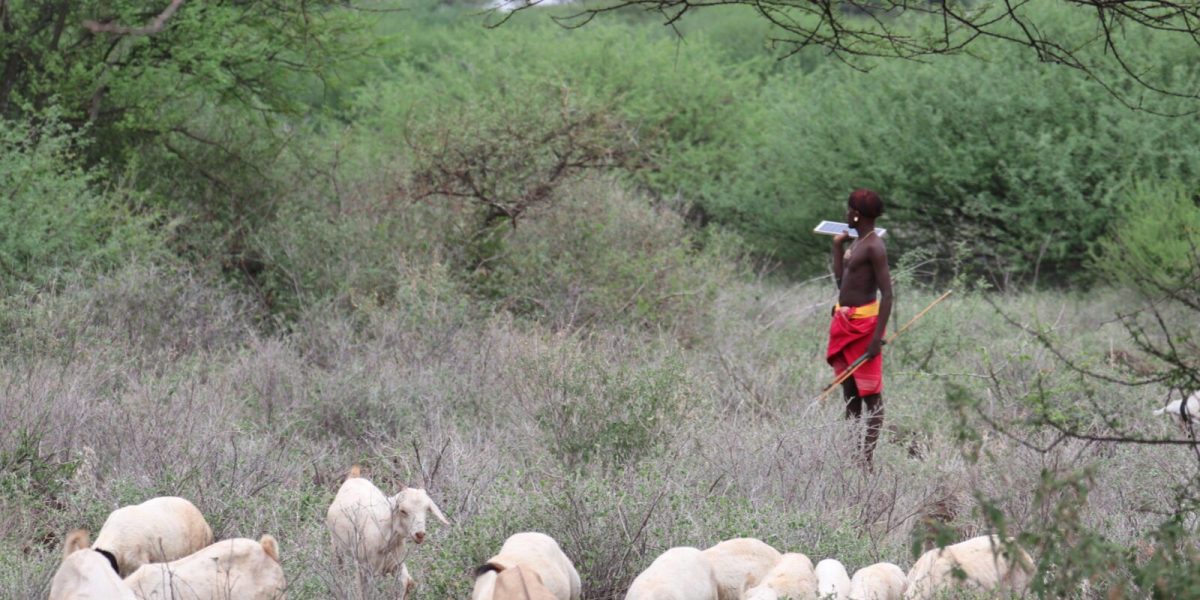
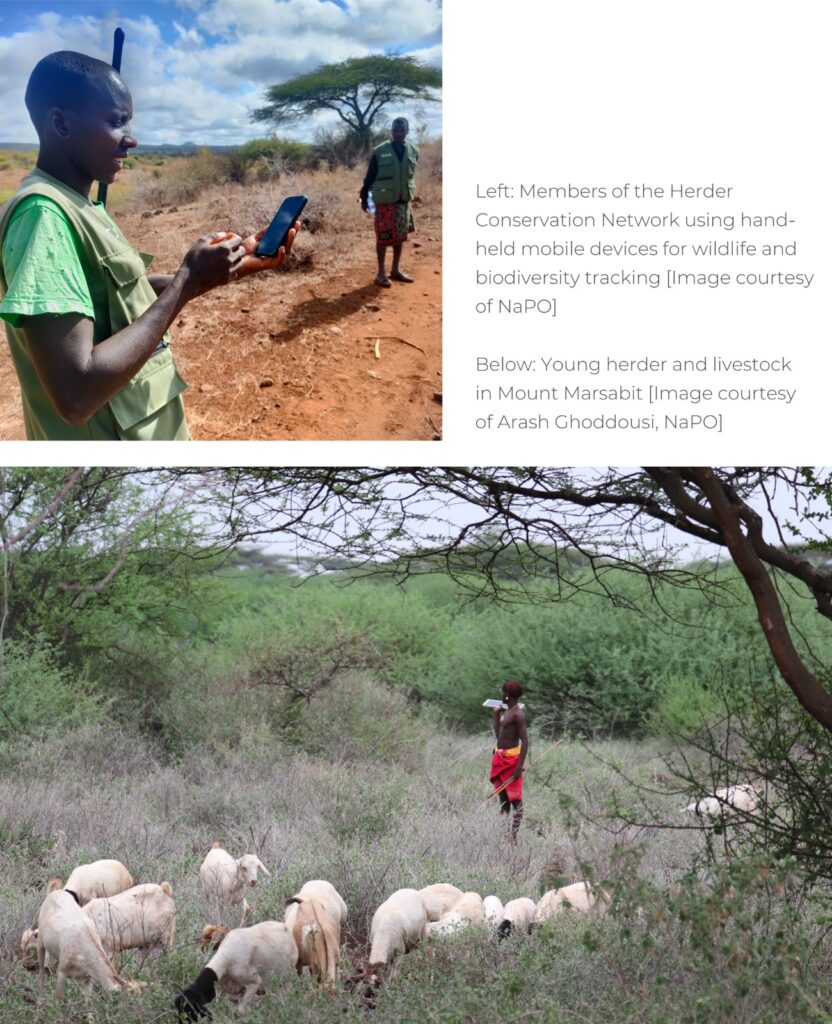
The youth-led non-governmental organisation (NGO) Nature and People as One (NaPO) is working with pastoralists in the Mount Marsabit region to restore dryland forests and rangeland ecosystems while integrating traditional conservation practices into natural resource governance systems. Using the ramat (stewardship) model, pastoralists engage in rotational grazing and seasonal migration. They also clear invasive alien species, protect native trees and rehabilitate traditional grazing corridors to safeguard communities against climate change. Consequently, 600ha of degraded land have been restored. The project also focuses on the inclusion of women, youth and elders in ecosystem stewardship to ensure that EbA action is guided by a ‘whole-of-society’ approach.22FEBA, “From Degradation to Regeneration: Community-led EbA in Kenya”, accessed June 7,2026. One innovative approach it uses is the NaPO Conservation Cup (NCC), which engages youth in a football competition that is coupled with hands-on restoration. Participating teams, which include women’s and girls’ teams, adopt restoration sites where they plant indigenous tree seedlings, practise farmer-managed natural regeneration using NaPO’s ramat methodology and remove invasive species. Teams are evaluated on both their football performance and their conservation results. In 2026 the NCC is working with over 700 young people in 34 football teams from seven communities surrounding the Marsabit Forest.23NaPO, “NaPO Launches Fourth Edition of the NaPO Conservation Cup: Mobilising 700 Youth Across Seven Communities to Restore Marsabit’s Forests and Rangelands”, LinkedIn, April 14, 2026. Elders are engaged in restoration activities and often participate in youth restoration days, ensuring that inter-generational knowledge and best practices are passed down. A Skills Lab offering participating youth training in photography, filmmaking and environmental storytelling has also been established.
In addition, NaPO is fostering knowledge exchange and collective action in conservation through its Herder Conservation Network (HCN). Herders have a deep understanding of their natural environment and are best placed to monitor ecological data to inform rangeland management. They are equipped with handheld devices that use GIS and tracking technologies, enabling them to report on wildlife movements, human–wildlife conflicts and changes in natural resources. The technology uses icons instead of text for herders to track ecological data, ensuring that those with low literacy can still participate.24SouthSouthNorth, “Technology, Tradition and Co-Existence: How One CDKN Partner Is Working with Pastoralist Communities to Monitor and steward their environment”, February 4, 2026. The HCN thus enables herders to act as knowledge brokers, informing conservation practices within their territories.
NaPO supported the validation and implementation of the Participatory Forest Management Plan (2024–2029), co-led by the SAKU Community Forest Association, the Kenya Forest Service and the Kenya Wildlife Service.25FEBA, “From Degradation to Regeneration”.
This centres pastoralist livelihoods and rights within the management of Mount Marsabit’s natural ecosystems, while promoting transparency and conflict resolution for shared forest assets.26FEBA, “From Degradation to Regeneration”. In the future, NaPO aims to include more herders in the HCN to scale up inclusive and participatory approaches to ecosystem management in the region. NaPO’s project thus aligns EbA action with KMGBF Section C considerations (including the contributions and rights of Indigenous peoples and local communities, different value systems and intentional considerations of intergenerational equity). This shows how EbA actions that apply a rights-based approach can accelerate improvements to livelihoods and ownership among local communities and marginalised stakeholder groups, including women and young people.
National Strategies to Align the Implementation of the Rio Conventions Through Equitable EbA Action
The three Rio conventions underpin the SDGs and Agenda 2030. By applying Targets 8 and 11 of the KMGBF, which advocate for EbA approaches, several objectives of the conventions can be achieved simultaneously. Even more targets are met if an HRBA approach is applied. However, to ensure such evidence is captured, robust national reporting channels must be established. In addition, strong institutional coordination mechanisms across various ministries and sectors can ensure that the impacts of EbA are accurately reported, in alignment with national development objectives. For example, in 2024 Kenya established the National Biodiversity Coordination Mechanism to address challenges in coordinating the biodiversity efforts of multiple stakeholders and sectors.27International Union for Conservation of Nature, “National Biodiversity Coordination Mechanism Launched to Enhance Biodiversity Conservation in Kenya”, August 9, 2024. The mechanism was established through a highly consultative process with state and non-state actors, including community representatives. The objective has been to facilitate the effective implementation of the country’s biodiversity goals at national, sub-national and community levels, as set out in Kenya’s Vision 2030.
Both national climate and biodiversity policies – including Nationally Determined Contributions (NDCs), National Adaptation Plans (NAPs) and National Biodiversity Strategy and Action Plans (NBSAPs) – offer entry points for integrating EbA measures and targets to accelerate progress toward national development goals. Inclusive EbA can also be leveraged to help achieve several national policy processes simultaneously. For example, Benin’s NAP emphasises the need to strengthen forest protection, restore degraded ecosystems and conserve biodiversity, while its NDC sets specific targets to establish 15 000ha of plantations by 2030. Its NBSAP sets a vision for 2050 in which biodiversity is conserved, restored and sustainably used.28Totin, Obossou and Ayimasse, “Traditional Knowledge Driving Local-Scale”. EbA action contributes to the implementation of all these policies while advocating for rights-based approaches to climate action.
Globally, there has also been movement through the UNFCCC’s Nairobi Work Programme, in collaboration with the Least Developed Countries Expert Group, to develop a Framework for Promoting Synergies Between Climate Adaptation and Biodiversity through the NAP and NBSAP Process. Under the UAE Framework on Global Climate Resilience adopted at COP28 in Dubai, countries are working to develop national adaptation monitoring systems by identifying national-level adaptation indicators aligned with the UNFCCC’s Global Goal on Adaptation.29Goodwin et al., Harnessing Ecosystem-based Adaptation.
This presents an opportunity to develop a globally accepted framework for tracking EbA action that is grounded in Section C considerations of the KMGBF. In the face of evidence that an HRBA for EbA can accelerate equitable climate and biodiversity solutions, there is also growing global recognition of the effectiveness of locally led adaptation that mainstreams gender and social inclusion into project design, implementation and leadership. However, less than a third of climate finance currently supports local action and less than 0.2% specifically targets locally led outcomes.30International Institute for Environment and Development, “Principles for Locally-Led Adaptation”, accessed June 7, 2024. The eight Principles for Locally Led Adaptation are important considerations in the design of EbA projects. At the same time, understanding local needs, customs and underlying injustices, among others, is crucial to ensure projects are tailored to specific contexts and priorities. The principles provide useful foundations to guide partnerships among diverse actors (communities, donor and recipient governments at multiple scales, NGOs and researchers) and are intended to encourage a rebalancing of power and the channelling of greater resources to where they are most needed. Section C considerations of the KMGBF can provide additional guidance on the ‘how’ of implementation. The case studies presented speak to the importance of continuous, meaningful leadership and participation by local communities in all EbA stages (for example, policy development, implementation and monitoring). Structured participation platforms (eg, community dialogues, knowledge-exchange events and deliberative platforms) help ensure that equitable EbA can be operationalised, while recognising communities as ongoing contributors to decision-making, not just beneficiaries.
Conclusion
Looking ahead, the CBD COP17 in Armenia and COP31 in Turkey are critical opportunities to profile evidence that advocates for an HRBA in EbA that is locally led and aligns with the KMGBF’s Section C. Integrating such evidence into these UN processes can ensure that equitable EbA action becomes a funding priority. National and subnational governments must also ensure that coordination mechanisms are established and capacitated to track EbA action across sectors and national development goals.
Forums such as the annual Community-Based Adaptation (CBA) Conference provide critical entry points for local actors to present evidence to strategic stakeholders and for EbA best practices to be scaled. Networks and platforms such as the CDKN EbA landing page, Panorama Solutions and FEBA are important knowledge brokers and conveners that can link evidence from the ground to strategic forums. They also create inclusive spaces for local actors, governments and funders to share knowledge and experience in implementing equitable adaptation approaches in various contexts. With 2030 fast approaching, an HRBA for EbA that centres local communities in climate action must be acknowledged, financed and implemented at scale to accelerate momentum toward achieving the goals of the KMGBF, the Paris Agreement and the SDGs.