









South Africa-UK PACT Green Hydrogen Economy Project

This project aims to improve job absorption in the future Green Hydrogen Economy in pursuit of a Just Energy Transition as South Africa seeks to reduce its carbon emissions.

This project (February 2021 – December 2022) supports the orientation of South Africa’s TVET college ecosystem towards the Green Hydrogen Economy (GHE) by providing insight on sectors with the highest economic and employment potential, and the timelines by which South African graduates will be required to have the requisite skills, as well as options for up- or re-skilling. 

The South African Green Hydrogen TVET Ecosystem Just Transition Strategic Framework study, has been co-developed by the South African Institute of International Affairs (SAIIA) and project consortium partners, alongside the Department of Science and Innovation (DSI) and other government stakeholders. The study applies advanced and economy-wide modelling of national energy systems, including hydrogen use, and their economic and GHG emission impact. Policy recommendations and strategic actions toward developing the desired GHE-TVET ecosystem are also put forth, targeted at various public and private stakeholders.

Study summary

Hydrogen is an energy carrier and industrial feedstock that could be the foundation of a new energy-industrial network based on renewable energy. There has been a global resurgence of interest in the use of hydrogen, notably green hydrogen produced from renewable resources,1 owing to its potential to help decarbonise sectors for which few alternatives presently exist. These sectors include long-haul transport, iron and steel production, long-term energy storage and liquid fuels such as kerosene and heavy fuel oil. Hydrogen is thus a likely enabler to achieve climate change policy goals, predicated on the notion that greenhouse gas (GHG) emissions resulting from economic activity should be as close to nil as possible as an objective for a movement towards 2050, which is now becoming the new frontier for climate policy ambition around the world.

Project design and recognition

Led by SAIIA, project partners included: National Business Initiative; University of Cape Town’s Energy Research Centre; Trade and Industrial Policy Strategies; and Bambili Advisory. 

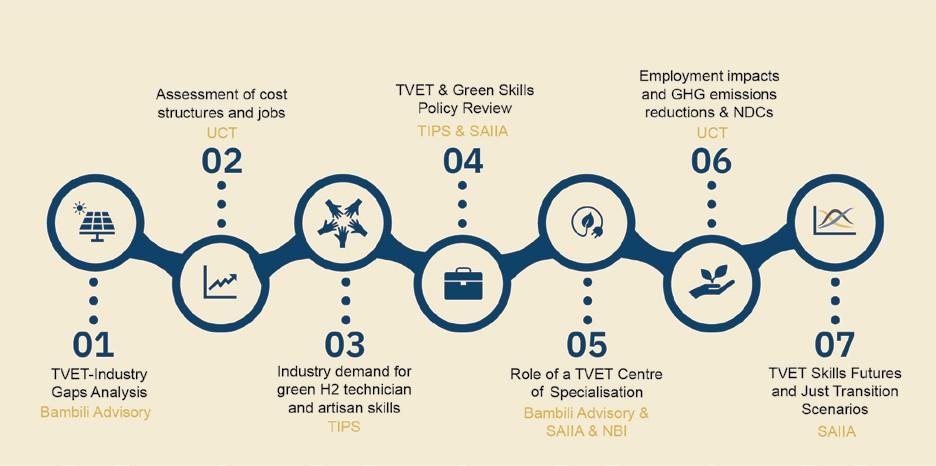
This study constitutes a synthesis of seven research outputs produced throughout the project lifespan, with the aim to consider opportunities, leverage points and risks relating to the South African TVET ecosystem, rooted in a systems innovation approach. 

Seven research streams feeding into this report

Source: Compiled by authors (SAIIA)

The seven research/workstreams used a variety of research methods, including economic value chain analysis, integrated quantitative economic modelling or forecasting, and methods from the field of futures studies.

Research consortium partners

saiia
Bambili Logo
UCT ERC Logo
nbi
TIPS Logo

Key Beneficiary

DSI Logo

Key stakeholders and primary beneficiaries represented on steering committee

DHET Logo
DTIC Logo
Sanedi Logo
TVET Logo
EW SWETA Logo

Timelines

Start Date: 1 Feb 2021
End date: 31 Dec 2022

Project Partners

UK PACT

UK PACT (Partnering for Accelerated Climate Transitions) is a £60m flagship programme under the International Climate Finance portfolio. It is part of the UK’s £5.8bn commitment to International Climate Finance by 2021 to tackle climate change. The three-year programme (2018-2022) is funded by the Department for Business, Energy and Industrial Strategy.

Experts in this Area