
Executive Summary
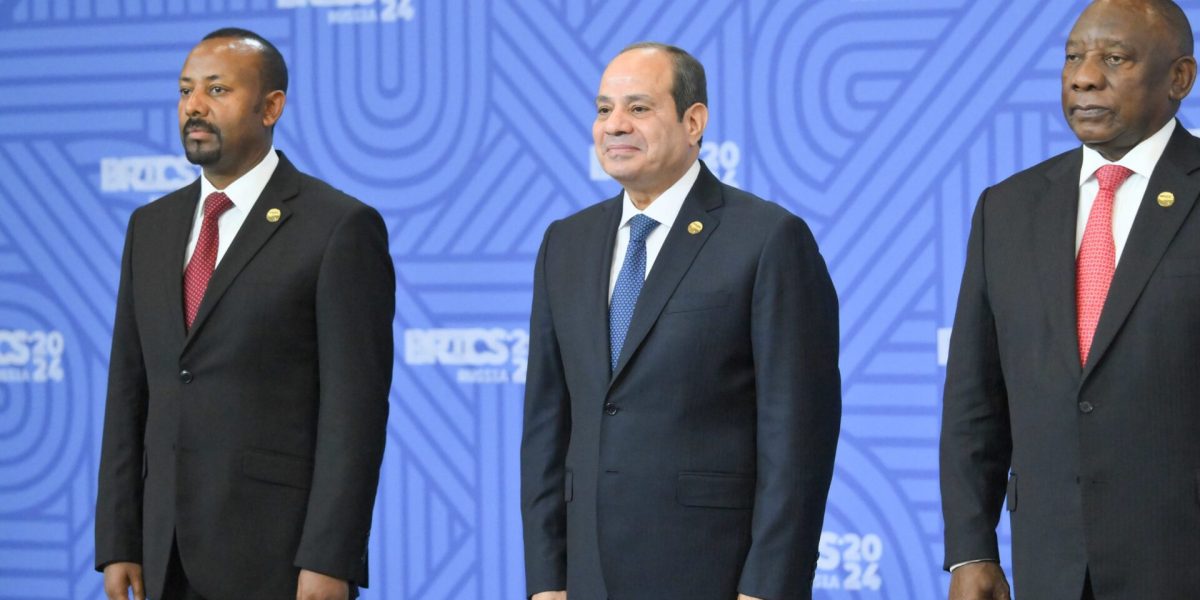
Africa is now one of the most represented regions in BRICS, with three full members, South Africa, Egypt and Ethiopia, and two partner states, Nigeria and Uganda.1BRICS now has 10 full members: Brazil, Russia, India, China and South Africa, joined in January 2024 by Egypt, Ethiopia, Iran and the United Arab Emirates, and in January 2025 by Indonesia. Saudi Arabia was invited but has not yet formally taken up membership. The African partner states are Nigeria and Uganda, among the wider group of partner countries announced in 2025.
This presents an opportunity to strengthen coordination around shared continental priorities, particularly economic integration, industrialisation and development finance. Yet the three members engage with the grouping through separate national channels and have no common reference point to compare positions before decisions are taken. A weakening trade order, contested supply chains in minerals and technology, recurring debt distress and rising geopolitical tensions all raise the cost of that gap.
This document sets out, from an African vantage point, where coordination among the three is achievable, where it is harder and what would make it work. It is offered to the three Sherpa teams and to the wider tracks – the Think Tank Council, the Academic Forum and the business, youth, civil and women’s councils – as a contribution to their preparations for the 18th summit in New Delhi, not as an instruction.
The central proposition is modest and practical. The three can adopt a coordinating practice comparable to that of the2The A3 refers to the three African elected members of the UN Security Council, who consult and, where they agree, vote together on African questions under a continental mandate. It is used here only as a reference point for a coordinating method; the three African members of BRICS hold no comparable mandate. A3 in the UN Security Council by comparing positions in advance and deciding on which matters a common line will serve their interests, while bringing a stronger collective voice into the room. This is offered as a method that can add value, not as a requirement or as something other regions in BRICS already do as a matter of course.
The African BRICS members do not represent the continent and should not claim to do so; coordination is worth pursuing for the leverage it gives each of them on questions where their interests already align.