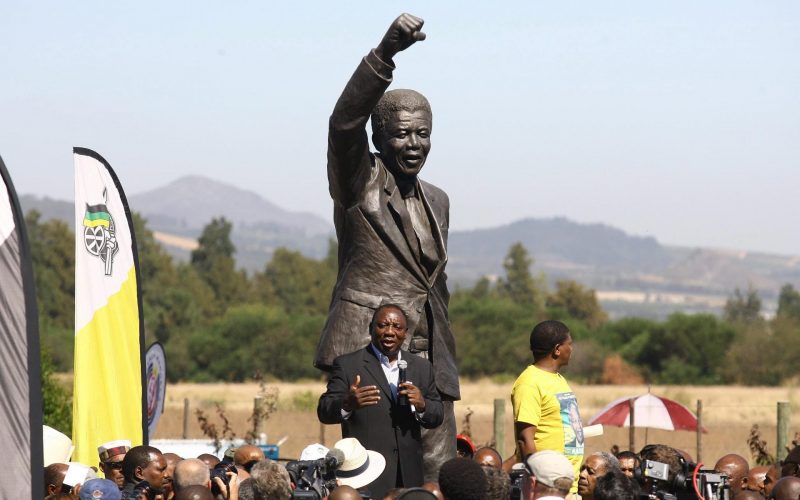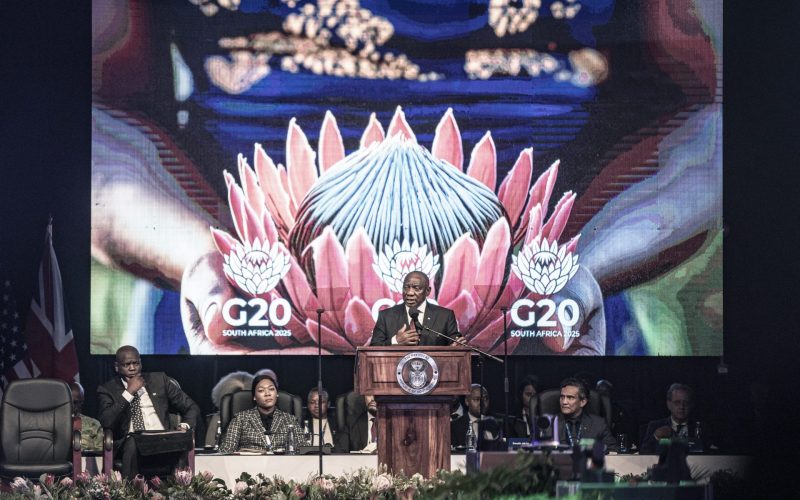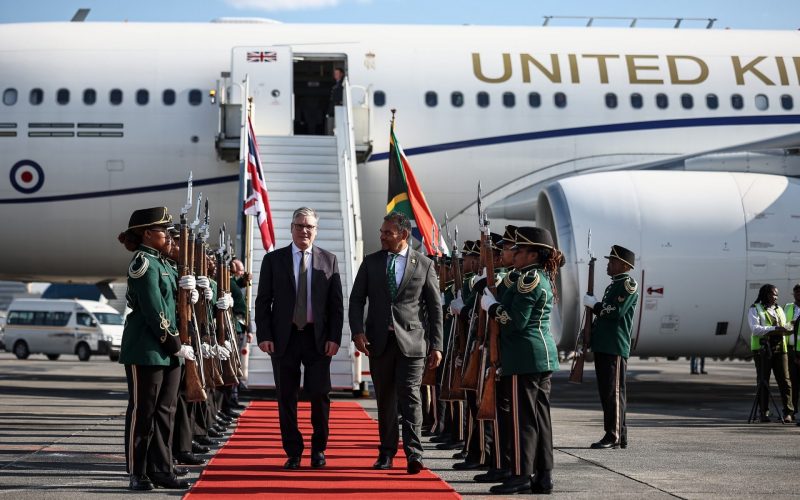
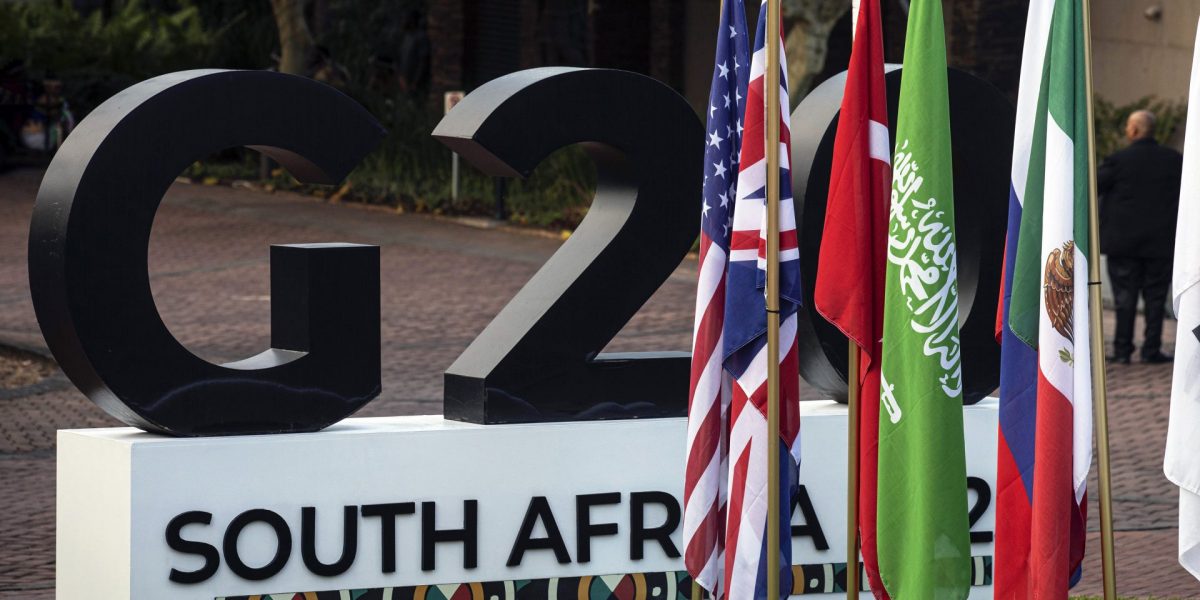
Last month, the Group of Twenty (G20) Summit was held in Johannesburg, South Africa, where the country’s agenda of global cooperation was overshadowed by the US’s boycott of the event. In 2026, the annual summit will be held in the US, where the Trump administration will have more control over the proceedings and the invitation list. Two experts from Council of Councils member institutions share their perspective on the 2025 G20 Summit in Johannesburg and what it means for multilateralism in the future.
G20 in South Africa: Progress Hindered by Divisions
South Africa set an ambitious agenda when it hosted the G20 Summit in November 2025. Focusing on issues critical to Africa and other developing countries, it sought to address climate-related disaster risk and structural barriers to development finance, including high capital costs and debt sustainability. It also aimed to advance just energy transitions through country platforms.
Yet, South Africa’s priorities were overshadowed by the US government’s opposition to its Solidarity, Equality, Sustainability theme, which was described as antithetical to America First policy; this, coupled with the Trump administration’s often open hostility to South Africa, culminated in the voluntary absence of the US from the G20 Summit and the disinvitation of South Africa from the US-hosted G20.
The adoption of a Leaders’ Declaration at the summit affirmed that unilateral exclusion from G20 processes does not give any state a veto over proceedings. But banning South Africa from the 2026 summit sets a precedent for future presidencies and raises questions about the troika (the previous, current, and future G20 presidency holders) as a mechanism for ensuring continuity. as a mechanism for ensuring continuity.
Each G20 presidency has traditionally built on previous outcomes. Yet 2025, more acutely illustrated divisions among other G20 members, especially on issues such as climate change, sustainable development goals, and gender and women’s rights. Holding the line on some of those elements in the outcome documents was a feat unto itself. Consensus will be much more difficult in the future.
Along with progress on finance and development issues, South Africa undertook a review of the G20 at 20 years, an outcome of the Rio Summit in 2024. The G20@20 review found there was a lack of execution on commitment when the G20 is not dealing with an immediate crisis. It also found that the agenda’s expansion had made the grouping less focused on coordination and cooperation on major global challenges such as finance, climate, and global health – areas where it can have an impact.
Most scholars would agree that the G20 should focus less on negotiating language and more on where its members can make the most difference by pushing for concrete agreements in global institutions.
President Donald Trump has already announced that the US’s G20 agenda will be much smaller, focusing largely on the finance track, thus abandoning much of the work of previous G20 presidencies. But a narrow economic focus on limiting regulatory burdens, unlocking affordable energy and securing supply chains, and pioneering new technologies and innovation – the three stated priorities of the US G20 – fails to recognise the skewed structural global financial rules that undermine development finance efforts in the Global South. The end result will heighten inequality at the expense of global interconnectedness.
The G20’s value comes from its membership, drawn from advanced and emerging economies across the world. Breakthroughs in many formal multilateral processes and institutions can be achieved by cooperation and coordination among the G20, although reaching consensus has been increasingly difficult. An absence of agreement will see subgroups of countries identify new ways of driving agendas on development, sustainability, and climate. How subsequent G20 presidencies craft a more streamlined agenda that recognises that finance and economy are interrelated to development and climate will determine the future efficacy and relevance of this informal grouping.
The US G20 Presidency: Breaking With Tradition
2025’s G20 Summit meeting will be remembered as the first such summit held on the African continent – but little else. The meeting produced the obligatory final communiqué with lofty rhetoric about global cooperation. But with leaders from Argentina, China, Mexico, Nigeria, and Russia skipping the summit, and the US declining to send anyone at all, nothing of substance was accomplished.
Trump’s decision to boycott the summit partly reflected his deep aversion to multilateral institutions, which the newly released National Security Strategy blamed for their “sovereignty-sapping intrusions.” South Africa’s slogan for the meeting – “Solidarity, Equality, Sustainability” – added to his aggravation. Knowing the president’s preferences, Secretary of State Marco Rubio skipped the G20 foreign minister’s meeting in 2025, arguing that the slogan was a euphemism for “DEI and climate change” and amounted to “anti-Americanism.” And Trump continues to peddle the debunked notion that South Africa is waging a so-called white genocide against Afrikaners.
By a quirk of the calendar, the US will host the 2026 G20 Summit in December at the Trump National Doral Miami resort. Trump has already announced that South Africa will not be welcome. With Secretary of the Treasury Scott Bessent complaining that “the G20 has become the G100” – 42 countries sent delegations to Johannesburg – Trump likely will limit the traditional practice of inviting non-G20 countries to participate as observers. One exception will be Poland, now the world’s twentieth-largest economy, which Trump has already invited.
The 2026 G20 Summit will break with tradition in other ways. In what Rubio calls a “new G20,” the US will narrow the agenda. Topics such as climate change, debt, development, inequality, and sustainability are out; in are three basic themes: “removing regulatory burdens, unlocking affordable and secure energy supply chains, and pioneering new technologies and innovation.”
The Trump administration argues that focusing on the sort of core economic issues that prompted the G20’s creation nearly two decades ago is the only way to ensure that the group remains relevant. The administration may be right. But its obvious scepticism about multilateral meetings and its preference for unilateral action will have most other G20 members wondering whether Washington will use the Miami meeting to make common cause or to impose US views on others.
This article was first published on the Council on Foreign Relations website.