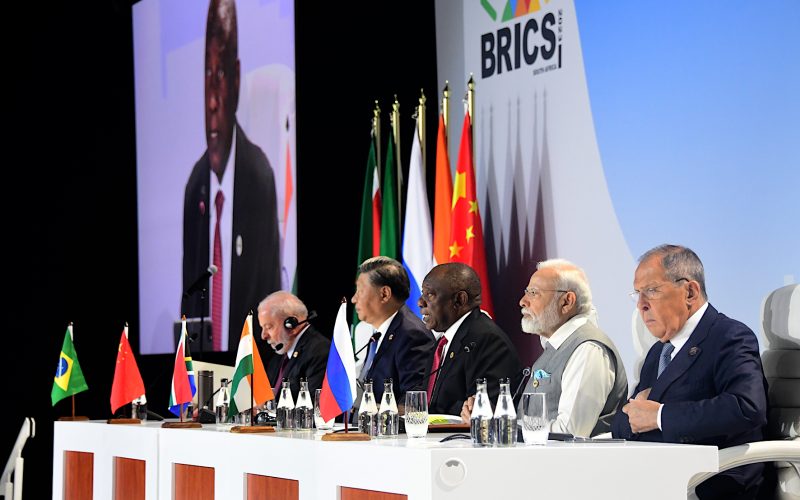

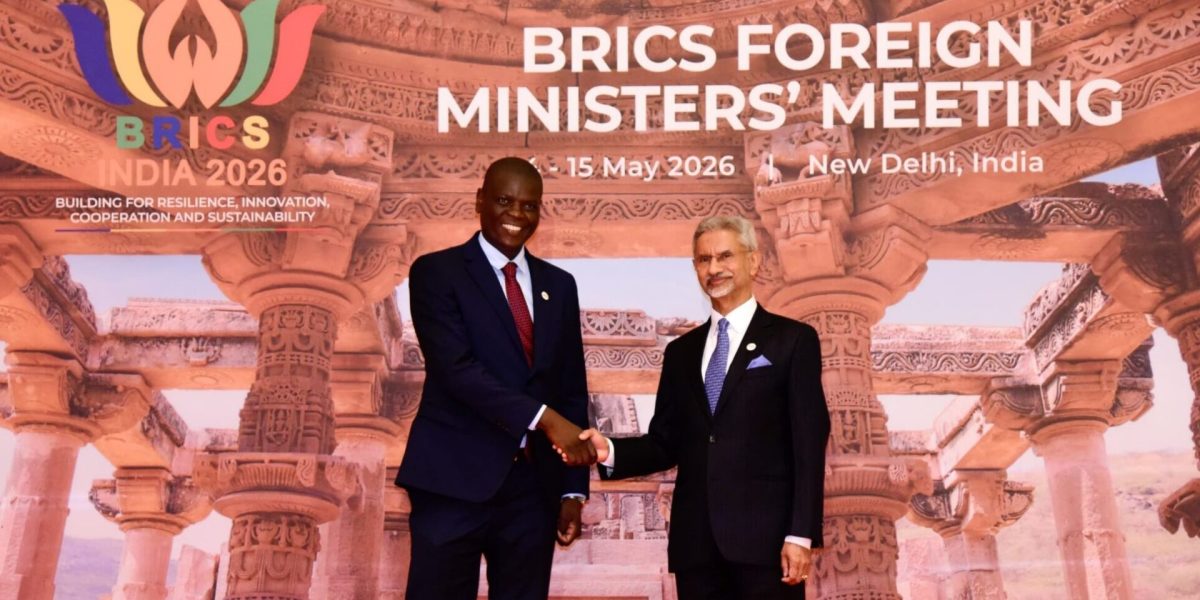
In May, the BRICS Foreign Ministers’ Meeting failed to reach agreement on a joint statement for the second consecutive year. This was largely due to an impasse over the Gulf conflict between Iran and the United Arab Emirates.
India has steered the year towards development finance and technology: local-currency settlement, tools for small businesses and start-ups, digital public infrastructure and rules for artificial intelligence (AI). The harder questions form the backdrop to that agenda: whether an enlarged grouping can agree on rules for its own membership, and whether leaders can adopt a declaration their foreign ministers could not. South Africa arrives having been declared unwelcome at this year’s G20, with January’s naval exercise alongside China, Russia and Iran on the record.
South Africa’s foreign policy has long worked as a balancing act, where non-alignment is claimed as agency rather than neutrality. Its influence is borrowed: lent by the constituencies Pretoria speaks for and the causes it takes up, rather than generated by economic size or military reach, and lenders can withdraw it. That is what the summit will test. So how does South Africa build influence, and what erodes it?
1. Speaking For Africa Is Over; Convening Africa Is the Job
For more than a decade, South Africa was the only African state at the BRICS and G20 tables, so African views reached those rooms through Pretoria by default. In New Delhi, Egypt and Ethiopia are members, Nigeria and Uganda are invited as partners, and the AU is among the invitees. For South Africa, continental legitimacy comes from consultation rather than from a seat. When Pretoria builds a shared African position before speaking, its claims to speak for Africa tend to be accepted. When it improvises, the claim collapses: at the BRICS Foreign Ministers’ Meeting in Rio de Janeiro last year, South Africa failed to build consensus beforehand on its bid for a permanent UN Security Council seat, prompting Egypt and Ethiopia to publicly refuse to endorse its candidacy. They insisted the AU should decide collectively and no joint statement followed.
This year’s South African Institute of International Affairs (SAIIA) and South African BRICS Think Tank (SABTT) African BRICS policy retreat found that comparing positions in advance gives each African member leverage where interests align. The difficulty, as a recent IPI brief shows, is that the three African members joined to diversify their options rather than align them, and no coordination mechanism exists; leverage lies in a broader strategy through the AU and the G20. New Delhi will show where that absence bites – in the expected paragraph on UN Security Council reform (which, in Rio, named only Brazil and India) and how it frames the AU’s place in the G20.
2. Borrowed Power Is Still Power
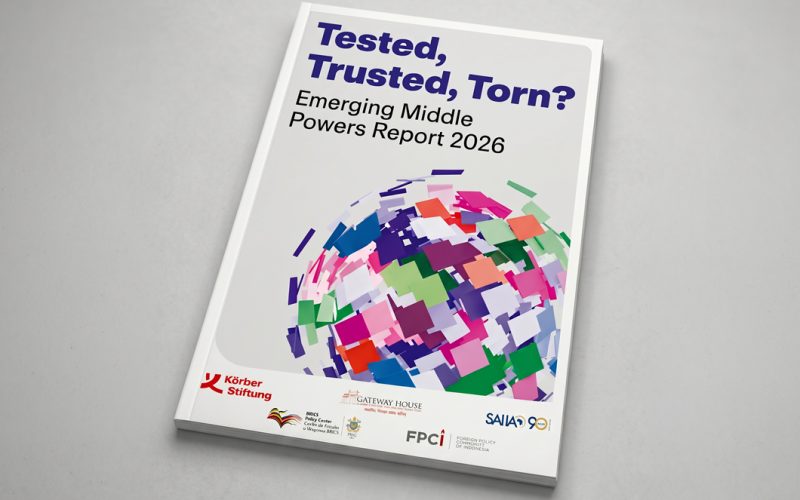
South Africa’s borrowed power rests on the moral capital of its democratic transition, African anchoring and patient coalition-building, which is amplified when the country channels a constituency larger than itself. The International Court of Justice (ICJ) genocide case is the clearest expression; read as middle-power lawfare, it used legal instruments to project an authority that material weight could never command. This year’s Emerging Middle Powers Report captures the divergence: while Brazilian experts rank trade as their top priority, South Africans debate the shape of the multilateral system itself, with 74% identifying BRICS as their country’s most important international institution.
3. The Sharpest Threat Is at Home – And It Is Not the Economy
Some of South Africa’s hardest domestic years, marked by rolling blackouts, stalled growth and unemployment above 30%, coincided with its G20 presidency, the ICJ case and a larger BRICS role, so elements of domestic weakness do not automatically translate into diplomatic decline. The sharpest and most underestimated erosion concerns continental legitimacy, specifically the treatment of African migrants in the country. If South Africa’s authority rests on moral leadership and an African anchoring, then recurrent xenophobic violence contradicts both at once. It is difficult to convene a continent whose citizens are periodically attacked – a reality that the leaders of Nigeria, Ethiopia and Egypt will bring with them to India. Visibility abroad is a wasted asset unless it is renewed by delivery, including how South Africa treats Africans within its own borders.
4. Normative Strategy Is the Right Tool and An Expensive One
South Africa’s reliance on norms and coalitions is usually explained as a deliberate choice, a structural necessity or an unexamined post-apartheid habit. All three apply in sequence: the choice predated 1994, in the non-alignment of the liberation movement; necessity reinforced it as the state dismantled its capacity for power projection; and strategy then hardened into repertoire, never reviewed from first principles. These are the right instruments for such a state, but they are high maintenance, demanding consistency across cases and before audiences whose expectations rarely align. January’s naval exercise shows the cost of treating the repertoire as a low-cost default: it earned South Africa little inside BRICS, since India and Brazil distanced themselves, and it came at the cost of clarity domestically and with other partners.
5. Retire the ‘Rising Powers’ Script
The literature on emerging powers assumes material scale and ascent; African cases fit badly and are read as deficient versions of the model rather than evidence against it. Recent research by SAIIA warns that coalitions built on an unexamined middle-power category become partnerships of misrecognition. Three patterns get lost: collective agency exercised upstream through the AU and the A3; ordering without a hegemon, as a recent article in Contemporary Security Policy argues; and engagement across several spaces at once as a stable strategy rather than fence-sitting.
Official South African discourse often omits the Sino–US binary: this February, Pretoria welcomed the AGOA extension and signed an economic partnership framework in Beijing within a single week, in the same developmental vocabulary. India’s line that BRICS is non-Western without being anti-Western is the same reading, and the point where Pretoria and New Delhi are likeliest to agree this weekend.
None of these fault lines will be resolved in New Delhi. What the summit will show is whether South Africa can convene the Africans in the room, hold a line where Gulf members cannot, and keep its case credible while its domestic record argues back. How South Africa built its influence was settled long ago, by history and by choice. Whether it keeps that influence is being decided now.